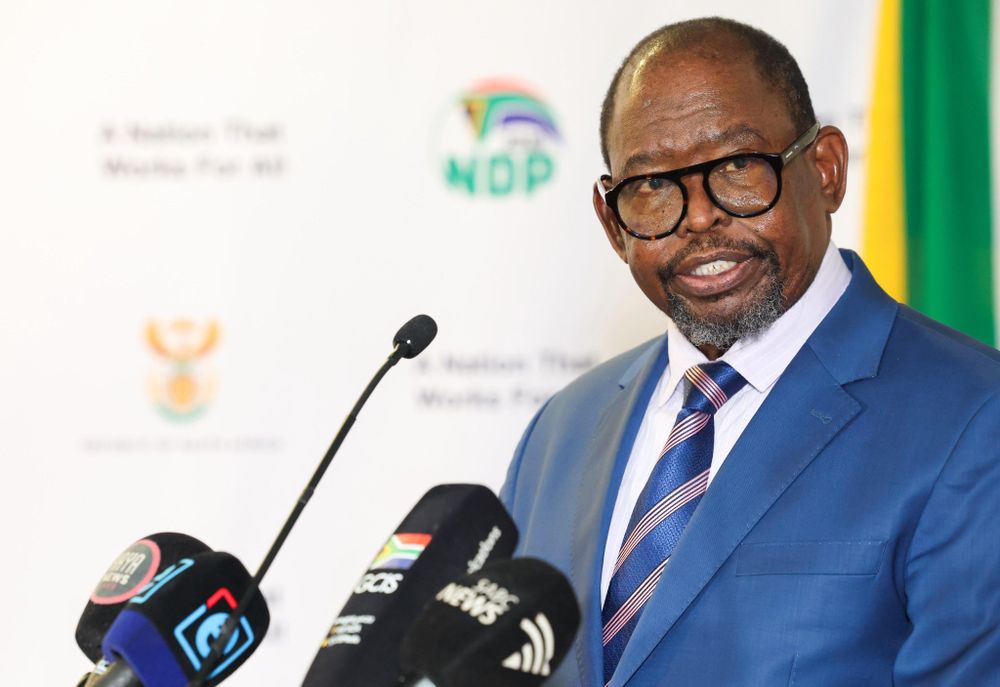





John Steenhuisen (Photo: dtic/X)
The agricultural organization Saai has accused John Steenhuisen, minister of agriculture, of distorting the recent ruling of the Pretoria High Court on private vaccination against foot-and-mouth disease (FMD) and trying to water down its importance.
Saai responded to Steenhuisen’s statement that the court case was largely due to the publication of the art. 10 scheme has been overtaken.
The scheme creates a formal framework in which producers play a central role, but under the strict supervision of state veterinary services.
Although participation is technically voluntary, strict requirements are set. Among other things, producers must be able to prove that their animals are fully traceable, registered on a recognized system and that their farms have official location codes.
Steenhuisen responded to the ruling and said that the government has consistently supported a coordinated approach between the state and the private sector for combating BKS and that the ruling is largely based on the scheme he presented.
According to Saai, the court did consider the scheme, but expressly found that it did not offer a substantial defense for the state’s position against private vaccination. According to the organization, the scheme provides at most for voluntary participation in the vaccination program and does not create a general legal ban on private vaccination.
Saai says the court found that the state could not prove where such a ban was legitimately created and that policy or practice that excludes private vaccination does not enjoy the status of legislation.
According to the organization, the court further found that the state’s opposition delayed the implementation of a solution during a national animal health crisis.
“The judgment is not a reckless precedent, as the minister now seems to want to suggest. It is a reminder of a basic constitutional principle: The government cannot prohibit South Africans from acting lawfully simply because officials prefer to centralize control.
“In a crisis, the state must use available capacity, not suppress it,” says Francois Rossouw, CEO of Saai.
The organization also rejects the minister’s warning that the ruling circumvents existing veterinary and medicine control measures. Steenhuisen issued the warning at a media conference on Monday.
Also read: Foot and mouth disease | 13.5 million vaccine doses; 4.4 million animals vaccinated


The two million doses have just arrived at OR Tambo Airport. (Photo: Dunevax)
According to Rossouw, the court order sets strict conditions for private vaccination, including prior notification to state veterinary authorities, details of the animals being vaccinated, the persons administering the vaccine, the cold chain and reporting after vaccination.
Rossouw says that the court ruling also does not limit the state’s role in the distribution of state-acquired vaccine.
“The court order expressly maintains the state’s power to allocate such vaccine according to its own strategies,” says Rossouw.
According to the organization, the purpose of the lawsuit was not to weaken the state’s role, but to prevent farmers, veterinarians, legal importers and other private actors from being prevented from getting involved in the fight against the disease.
Saai also asks why it took nine months to send South African virus strains to the Pirbright laboratory, six months to get the art. 10 scheme and why the importation of vaccine on the required scale has only recently been announced.
“The question is not whether the government should play a role. Of course it should. The question is why the minister and his department fought so hard to prevent others from helping,” says Rossouw.
The organization calls on the minister and the department to implement a vaccination model based on cooperation between the state and the private sector and to allow private players to contribute to the fight against foot-and-mouth disease.