
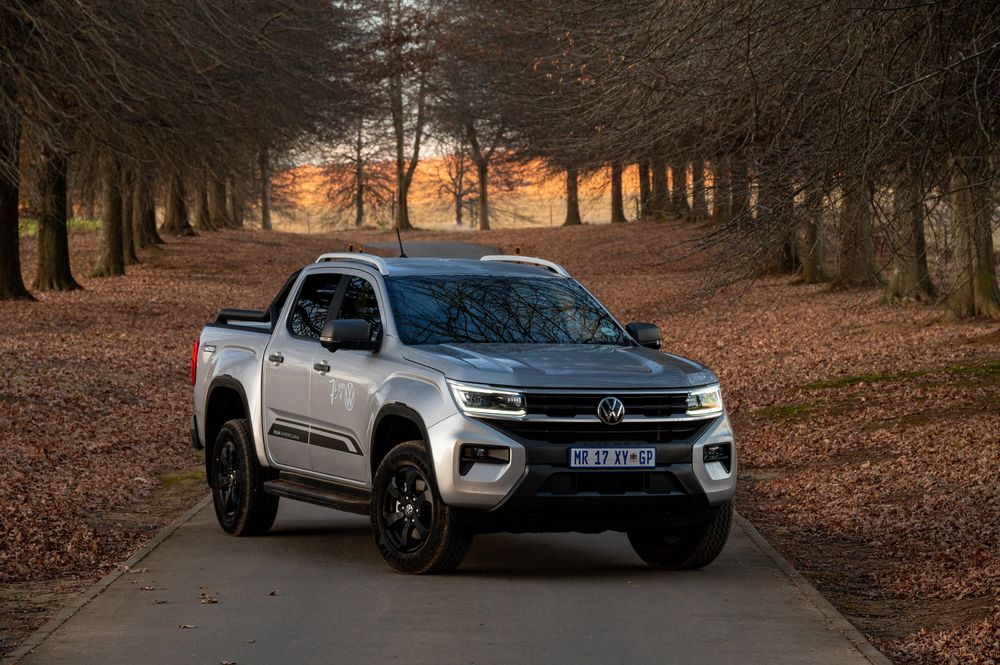
IMOTO: VOLKSWAGEN AMAROK
A lorry accident on the R75 road between Robert Sobukwe and Gqeberha, in the Eastern Cape, caused the worst thing to happen, the plane that was going to take me back to Durban.
Then it was the last leg of our trip which lasted a whole week from Durban up to Lesotho and ending in Gqeberha.
The plane was to return home because we were visiting all these places in various Volkswagen Amaroks.
The Amarok went on sale in South Africa in 2010, at which time Volkswagen was involved in it.
Things turned around in 2023 when the new VW teamed up with Ford to build it.
In fact the latter is built right here in South Africa at the Ford factory in Silverton, Pretoria.
Since it arrived this time, its purchase has gradually increased since last year they sold 4,290. Since the beginning of 2026, 2,004 have been purchased.
It’s a number that sounds smaller than the competitors you can count Toyota that sells more than 2000 Hilux every month, its cousin is Ranger and Isuzu D-Max.
It is possible that the ones I am counting are more than 30 individual models, but VW hopes to expand by adding more models that feature the Dark Label.
We start the journey and choose a PanAmericana with a more powerful engine than any Amarok on sale.
We took the N3 from the center of Durban towards Nottingham Road, Mngeni.
It was about to stand up and I saw trucks and other cars left behind.
If Duma’s people were on the street, there is a good chance that you would have seen me posted on their Facebook page and cried for me.
After all, it is not heard when it is at speed, only you can see the cars moving away from the poles on the side of the road and they look fast.
The engine installed here is Ford’s 2.3 liter turbo petrol.
It has a power of 222kW, a torque of 452Nm and a 10 speed auto transmission.
It is not the Raptor that is bigger and makes a noise that tells you that the speed is increasing.
If you’re curious, it goes from 0 to 100km/h in 7.6 seconds and tops out at 180km/h.
It’s almost the same time as the old Amarok which had a 3.0 turbo V6 diesel engine with 190kW. But it kept it at 207km/h
Because it was getting dark, the LED lights made it easier to see the way.
We woke up in the morning to freezing cold because the numbers were below 10 degrees. It was getting in and I pressed the button to heat the leather seats.
Because there were three of us, we threw the luggage into the rubber bucket. We were not worried about its safety because it has an electric roller shutter and the rear lid also locks when you lock the car doors.
But I’m disappointed we took them out completely dusty since we were driving in the dirt.
We were walking along the sands of Mahlutshini and Lotheni towards the Khahlamba mountains.
This PanAmericana has 4Motion which means it has all-wheel drive if you want. On the dirt, most 4x4s put them in 4high range for better traction, but the Amarok has 4 Auto that sends power to the wheels it needs.
We put it there because even on the asphalt road I could feel it holding better in the turns. After all, it has all-terrain tires that didn’t give me good comfort when I hit the corners at speed, it pulls in two in 2h.
The mountains of Khahlamba were covered in snow and it was rustling as we climbed the Sani Pass towards Lesotho. When the hills started to get difficult we put it in 4low range but at no point did we use the diff lock.
When we got down to South Africa, the hill descent control was working. I liked that you can slow it down with the adaptive cruise control buttons on the steering wheel.
PanAmericana on the open road consumed 11.7 liters of petrol per 100km.
As the trip progressed we switched to a PanAmericana with a diesel engine.
The way it looks and comes is the same.
It has 18-inch rims fitted with all-terrain tires, Harman Kardon speakers, a large touchscreen infotainment system that connects to a mobile phone with Apple CarPlay/Android Auto, shows directions and more, has full-body cameras and more.
The engine they teased under the bonnet is a 3.0 liter V6 turbo diesel.
It has a power of 184kW and a torque of 600Nm as well as a 10 speed automatic transmission.
It has captured my heart with the way it sends power to the wheels, all if you will as it also has 4Motion.
It’s smooth and its torque makes it quick to power up, especially when you’re going uphill.
I also like the little whistle that the turbo plays that makes you feel that the speed is increasing.
We are traveling on the R617 between Underberg and Kokstad, the holes that have not yet been buried in the road we were hearing about because of their comfort.
The way the Amarok moves on the road is like an SUV with a body. As for the Rangers, there is still a lot of work for the rivals to do to reach their level by being comfortable.
The road through Matatiele, Mount Fletcher went up to Naude’s Nek Pass, we were not wondering about its height, instead we were enjoying looking at the beauty of the Eastern Cape. Climbing Naude’s Nek Pass was not difficult if you put it in 4 low range and climb. And its height made it hit the ground.
We even went to the small town of Barkly East.
That gave us the opportunity to switch to Amarok Life the next day.
You can see the R58 road between it and Aliwal North, it is at a high level because of the way it is maintained and it has nice curves that show you the beauty of nature.
Before the sun came up, the heater was working in the car since here the seats are cloth and you can’t heat them but they support your spine.
Like other models, it has a large touchscreen infotainment system with Apple CarPlay/Android Auto, leather steering wheel, LED headlights, 18-inch rims, front sensors and a lockable trunk.
Even though it has a smaller engine than the PanAmericana, we have raced it and I felt it is not as slow as the Isuzu D-Max with a 1.9 liter diesel engine.
The Amarok Life has a 2.0 diesel turbo with a power of 125kW and a torque of 405Nm. The gearbox is a 6 speed auto.
The one we were traveling in had 4Motion and a diff lock but there was no need for it because we were traveling on tarmac and passed through Hofmeyr and entered the N9 to Robert Sobukwe (Graaff Reinet).
Probably if you were like us traveling in places where you don’t need a 4×4, you can look at a 4×2 that is less expensive.
It was the last day when the storm left and the road was closed with a short distance to reach Gqeberha.
We were forced to turn around and enter the dirt for R400. Then we went back to the PanAmericana for petrol and said we were trying to be fast and it said that we would arrive and point it out.
Our trip ended up being more than 1,500 kilometers and it showed us that the Amarok is comfortable on the road but it can handle any conditions you put it in.
Price:
Amarok DC Life 2.0 TDI – R801,000.00
Amarok DC PanAmericana 2.3 TSI – R1 099 000
Amarok DC PanAmericana 3.0 V6 TDI – R1,190,900.00