






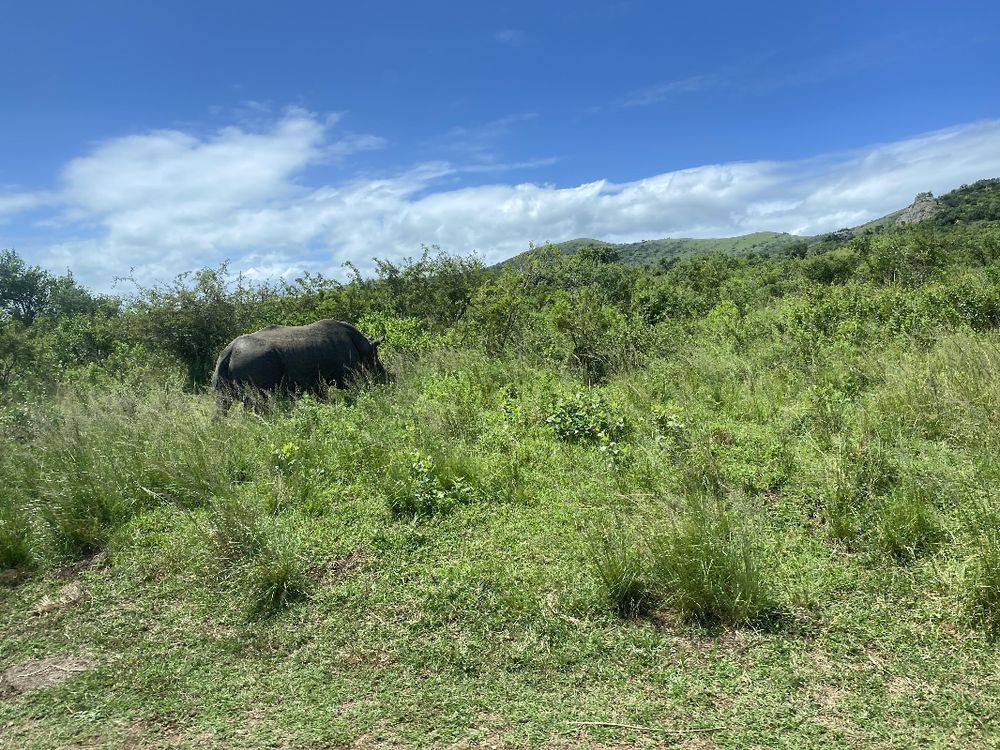
KZN Wildlife’s various programs, involving high-quality technology, to prevent the killing of rhinos for the purpose of stealing their horns, which are said to be meat, are bearing good fruit in foreign countries, in the continent of Asia.
This was revealed by the Minister of Economic Development, Tourism and Environment in KwaZulu-Natal, Mfu Musa Zondi, at Hilltop Camp, Hluhluwe-iMfolozi Park (HiP) on Tuesday.
Zondi revealed that in January this year, there was not a single rhinoceros killed in the reserves monitored by Mvelo KZN Wildlife.
“This did not happen by chance, but it was a work done with cooperation and determination,” said Zondi.
He mentioned that this was the result of intelligence work, which includes advanced and advanced technology.
“A number of park guards have been deployed, technical surveillance equipment has been installed, and a plan to remove rhino horns has also been implemented,” said Zondi.
The plan to remove the horns of the rhinoceros started in April 2024. It was the last solution that the Environmentalists reached, following the uncontrollable manner in which they were killed.
Zondi said that it also helped to strengthen intelligence where different law enforcement agencies are used.
He said that cooperation with the communities was not left out as it also played a role in ensuring that the methods of rhino poaching are prevented.
“We have moved to do something because there is already damage done, we focused on preventing the damage,” he said.
He said that KZN Wildlife has shown that this type of organized crime can be defeated if there is a fight.
The special officer of Mvelo KZN Wildlife, Mr. Sihle Mkhize, said that in the last three years the level of rhino poaching was very high.
He said that they started by saying that all the workers of the reserves were forced to be tested with machines to catch them if they lied – it was checked if they knew anything about the killing of the rhinoceros, which they did after discussing with the activists of the workers about this plan.
He said he started in front, followed by all the workers who were in the fight against the killing of the rhino.
“Many came out on top in this program, while a few who failed, were removed from the reserves with rhinos,” said Mkhize, who said there was a lot of controversy over this.
“All these efforts have helped a lot in fighting the problem of rhino poaching,” he said.
He said that it also helped them a lot to work with the communities, including the 10 chiefs who built the reserves in Hluhluwe and its surroundings, board members, and it was then agreed on other things including that the communities should also benefit from the reserve.
“Some of the jobs, which do not require much skills, we agreed that we will go to the community and hire those people,” said Mkhize.
He said they also opened up the opportunity for them to buy other products from nearby communities, he mentioned things like eggs and so on. He said they also taught them how to become businessmen who can provide products that are needed without problems.
Among the technologies brought to HiP, is the Nerve Center which is responsible for the surveillance of those who enter the reserve in an inappropriate manner.
Basically, this center monitors the operation of a network of cameras installed in different areas of the park.
Like lightning, these cameras are able to capture several photos of people passing by, and also take video. Suddenly, when he sends you to this center, a message is sent that there is a danger inside the reserve.
Those at this center are about to take appropriate measures such as sending drones that run at a distance of approximately 87km per hour, to go where it has become clear that someone has entered the reserve illegally. They also take their own pictures. There are also trained dogs that can follow a trail by scent, which can search until they find the criminal. There is also a helicopter, which also arrives suddenly at the scene of the damage.