
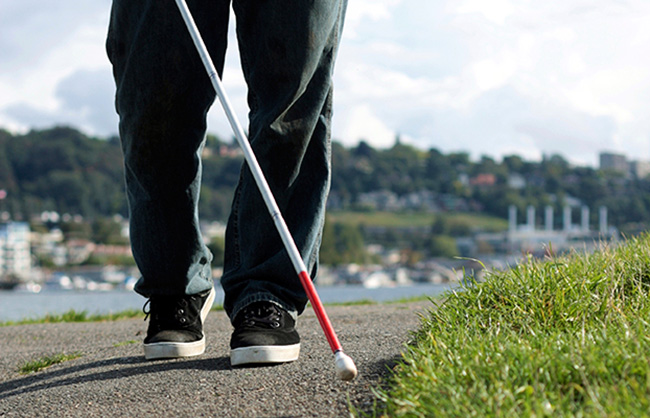



Thousands of blind and visually impaired learners in South Africa are left without essential skills to navigate their world safely and independently. (Photo: societyfortheblind.org)
Thousands of blind and visually impaired learners in South Africa are being left without essential skills to navigate their world safely and independently, warns a new report by civil rights group Section27.
The organization launched the report at the end of human rights month and says it exposes a serious gap in the country’s education system: the lack of orientation and mobility training for learners with visual impairments.
“The report clearly shows that thousands of learners without this support not only struggle to adapt to school, but also have to face their environment on a daily basis without the necessary tools to be safe and independent.”
What does this training involve?
Orientation and mobility training helps learners understand where they are, where they want to go and how to get there safely.
“In practice, this means that learners learn how to navigate school grounds, cross streets, use public transport and even carry out everyday tasks such as cooking. These skills are essential to building self-confidence and participating fully in the school environment,” explains the report.
According to Section27, it is precisely these skills that form the basis for independence and participation in society.
“It is not an added extra. It is a core component of development and education for learners with visual impairments. Without it, inclusive education remains merely an ideal and not a reality.”


(Archive photo: Adobe)
Shocking shortage of experts
Despite the necessity of this training, access to it remains extremely limited in South Africa.
The report shows that there are only around 50 professional orientation and mobility practitioners in the country. Furthermore, data from 2023 shows that only five of the 23 schools for the blind employ a dedicated mobility trainer.
“This means that one practitioner is responsible for between 40 and 45 learners, which makes it virtually impossible to offer quality and consistent training,” says the report.
Section27 warns that this deficit has far-reaching consequences.
“Learners without training struggle to move safely and independently. They are often forced to rely on peers for help, which undermines their independence. There is also a greater risk of injury and it becomes more difficult to adapt to new environments.”
Right to education in jeopardy
The organization further emphasized that the lack of support not only causes practical problems, but also has constitutional implications.
“Over time, this situation undermines learners’ autonomy and limits their ability to have full access to the right to basic education as guaranteed by the Constitution.”
According to the report, many learners are left to fend for themselves and have to find their way in environments not designed for them.
“The reality is that many of these children have to navigate their school and daily lives in spaces that are not inclusive and without the necessary support to do so safely.”
Systemic obstacles
The report further points to several systemic problems that worsen the situation.
“There is insufficient funding, a lack of formally recognized positions for practitioners, limited training programs and no national standards for orientation and mobility services.”
Section27 believes that these obstacles make it almost impossible to properly implement the necessary services.
“As long as these systemic challenges are not addressed, learners with visual impairments will continue to fall through the cracks.”
Urgent call for reform
The organization makes an urgent appeal to the authorities to act effectively.
“There is an immediate need to create funded positions for orientation and mobility practitioners in schools, integrate this training into the curriculum and develop minimum norms and standards for these services,” says the report.
Furthermore, it is requested that training programs be expanded to increase the number of qualified practitioners nationwide.
“The expansion of these services will make a significant difference to blind and visually impaired learners’ school experience. It will help them move safely, participate fully in school activities and develop the independence needed for life after school.”
Ultimately, the report makes it clear that truly inclusive education is not possible without mobility and independence.
“Inclusive education cannot exist without learners having the ability to navigate their environment independently. Access to orientation and mobility training is therefore essential to protect their rights to dignity, safety and basic education.”
Section27 warns that without urgent intervention, thousands of learners will continue to be left without direction – literally and figuratively.