

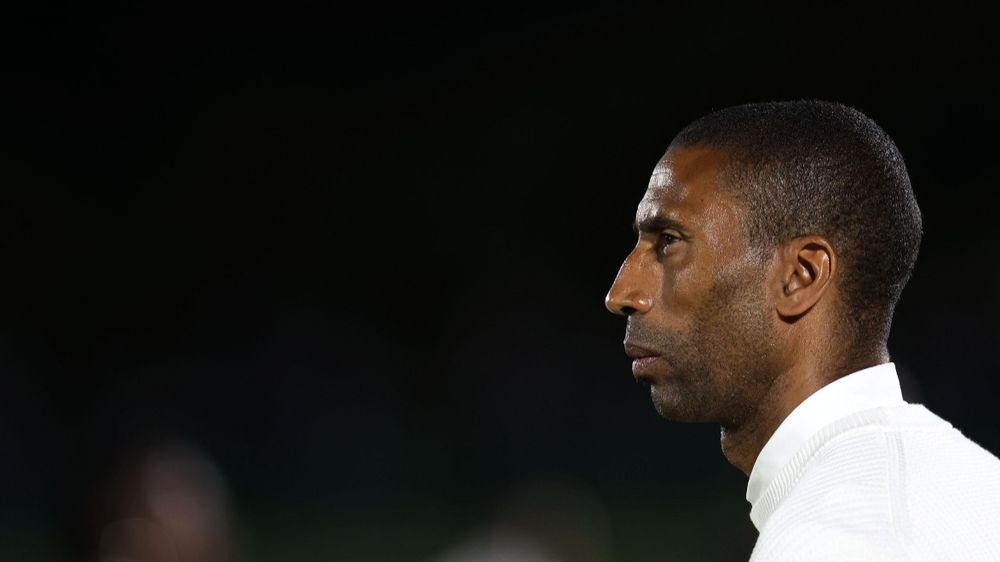



Lt. Gen. Nhlanhla Mkhwanazi testifies for the last time before the ad hoc committee. (Photo: Parliament/X)
Lt. Gen. Nhlanhla Mkhwanazi, the KwaZulu-Natal police commissioner, thought there was some kind of takeover of the government going on – hence the decision to convene a media conference and reveal his suspicions about political interference in police investigations to South Africans.
“Once you control the security group, you take over the country and this is what we saw happen,” Mkhwanazi said on Wednesday on the last day of the parliamentary ad hoc committee’s session.
This committee’s investigation into the damning allegations Mkhwanazi made at this media conference in July last year has now been finally completed.
Mkhwanazi explained on Wednesday in response to Glynnis Breytenbach, DA-MP’s last questions, that the media conference took place immediately after he received a statement from Gen. Fannie Masemola, the national police commissioner, received. In this statement, the national commissioner distanced himself “from what was happening”.
“I kept saying, ‘General, these files are gone. Did you authorize it? There’s a lot of things going on. Did you authorize it? He said no.
“And I said: Declaration,” Mkhwanazi explained.
With this, Mkhwanazi insisted on a statement from Masemola on this. He also did not want to do anything until Masemola provided him with such a statement.
“I kept waiting. I kept asking for an explanation. I finally told him (Masemola): “We have to speak publicly now and tell South Africa what is happening, because it doesn’t seem like we are finding a solution.”
Mkhwanazi then indicated that he wanted to hold a media conference.
“He (Masemola) said I could. But before that, Masemola had to help me clarify this issue (the dissolution of the special task force for political murders in KwaZulu-Natal) by means of a statement.
“Then he (Masemola) said: Good.
“And when I got that statement, I said, ‘Now I can move. Nobody can point fingers at me now.'”
Masemola, in turn, told the ad hoc committee this week that he thought Mkhwanazi had gone slightly overboard with the media conference.
“I (at that stage) heard stories many times… that things were going to get attention,” Mkhwanazi defended himself before the committee.
According to Mkhwanazi, Masemola even committed himself at one stage to working with pres. Cyril Ramaphosa to speak as soon as the president returns from a state visit.
“I felt: No. I don’t think it’s ever going to happen.”


General Fannie Masemola also testified before the ad hoc committee this week. (Photo: Parliament/X)
Why camouflage?
Breytenbach then, out of interest, as she indicated, wanted to know why Mkhwanazi addressed the media at the time in camouflage uniform of the police’s special task force, instead of his usual police uniform or a suit of clothes.
“As things started to build and we assessed the danger we were facing, I spoke to task force members and told them, ‘I think there is some kind of government takeover going on. When people want to control the security group, they are going to take over the government.’
“And we reached a stage where we had to face the enemy directly. So let’s communicate a message directly and indirectly.
“I asked the national commissioner for permission to dress like that and he gave me permission. In any case, I still have my uniform and that’s why I put it on.”
Breytenbach also wanted to know from Mkhwanazi why he thought there was a power that wanted to take over South Africa.
Analysis indicated that Lt. Gen. Shadrack Sibiya, the now-suspended deputy national police commissioner, will become the police chief, Mkhwanazi replied.
Sibiya is alleged to have close ties to crime syndicates and to have interfered in politically motivated murder investigations.
“Sibiya’s relationship with other key players within the security group – from intelligence to the NPA to presiding officers within the judiciary – would make it easy for them to drive the country in a certain direction,” testified Mkhwanazi.


DA MP Glynnis Breytenbach (Photo: Parliament/X)
“Members of parliament may not know this, but as soon as you control the security group, you take over the country. And that’s what we saw happen.”
“We know that,” Breytenbach pointed out and then asked: “I assume that you can prove these connections between Sibiya, the NPA and the judiciary?”
To this, Mkhwanazi replied: “Dear member, you know the court process regarding the admissibility of evidence. There are things that can be practically true, but are not admissible in court.”
Mkhwanazi therefore argues that his alleged evidence was collected in ways that would not be admissible in court. “We had to go beyond the normal way of gathering evidence because of the enemy we see in front of us.”
“Are you saying that you collected evidence illegally?” Breytenbach wanted to know.
“We obtained that evidence through intelligence methods,” Mkhwanazi replied.
Breytenbach started to laugh and then said: “Yes, this is an answer to a question.”