



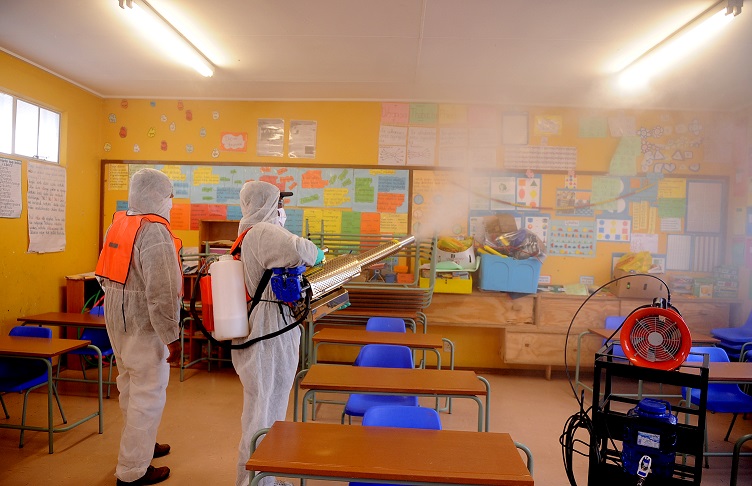
A school is being disinfected. (File photo: Ayanda Ndamane/ANA)
The Special Investigation Unit (SUE) has reached settlement agreements of R25 million with several companies and individuals linked to controversial covid-19 cleaning contracts awarded by the Gauteng Department of Education.
The agreements follow a ruling by the Special Tribunal in 2022 in which contracts worth R431 million were reviewed and set aside. The contracts were awarded to service providers for the disinfection, decontamination and cleaning of schools during the covid-19 pandemic.
According to the SOE, some service providers and individuals linked to the Chachulani Group Investment Holdings respondents have agreed to repay a total of R25 million to the SOE. This is out of the R40 million paid by the Gauteng Department of Education.
The settlements include various companies and individuals, including Muta Investment Holdings, Netvision Energy Savers, Psychin Consulting, Home Ground Trading 1105, Mpale Investments Holdings, Finds Energy Suppliers, Favored Street Properties, Mozambula Group, Imani Portfolio Holdings, Twin Cam Trading, Naledzi Investment Trust, Ofhani Negota and Munshedzi Ivy Motau.
The service providers have agreed to have retained amounts debited from their respective bank accounts. This includes the following: R707 892 from Chachulani Group Investment Holdings’ bank account; R1.7 million from Netvision Energy Savers’ account; R1,68 million from Mpale Investments Holdings’ account; R12.89 million from two foreign unit trusts of Naledzi Investment Trust; and R8 million from Naledzi Investment Trust’s bank account.
According to the SOE, the financial institutions involved must pay the money into the SOE’s bank account within seven days after the tribunal granted the order.
The SOE says the settlement follows the Special Tribunal previously granting an order to preserve assets worth R27 million pending the final settlement of the review application.
The investigation found that the Gauteng Department of Education deviated from normal procurement processes after schools were closed during the height of the pandemic and later reopened in terms of covid-19 regulations.
As part of the preparations for the reopening of schools, schools where covid-19 cases have been reported have had to temporarily close for decontamination and disinfection.
The SOE’s investigation found service providers were sourced informally from existing supplier databases, references and WhatsApp messages, without the involvement of the department’s supply chain management department. This division was responsible for the acquisition and selection of service providers.
The investigation also found the procurement process was not cost-effective. Service providers were not paid per square meter for the cleared area. According to the SOE, a senior official seemingly arbitrarily decided to offer between R250 000 and R270 000 for the disinfection of primary schools, between R250 000 and R290 000 for high schools, and between R250 000 and R300 000 for district offices.
The SOE says the amounts were not in proportion to the work done or the cost of the materials used.
The unit further found that the selection and appointment of the service providers took place in a random, unfair and unequal manner, contrary to the requirements of article 217 of the Constitution. Senior officials involved in the procurement process also admitted that prescribed supply chain processes were not followed.
The tribunal ordered the service providers to submit full financial statements and records, explain how they were appointed, indicate what services were provided, disclose the amounts paid to them, and enable the SOE to calculate the profit made from the contracts.
The service providers have meanwhile agreed to formally withdraw their appeal before the High Court in Johannesburg.
“This settlement is a critical outcome of SOE’s continued efforts to recover public money lost during the national state of emergency due to covid-19,” the statement said.
The SOE says it remains committed to protecting public money, restoring integrity in procurement processes and ensuring that those who profit illegally from government contracts are held to account.