





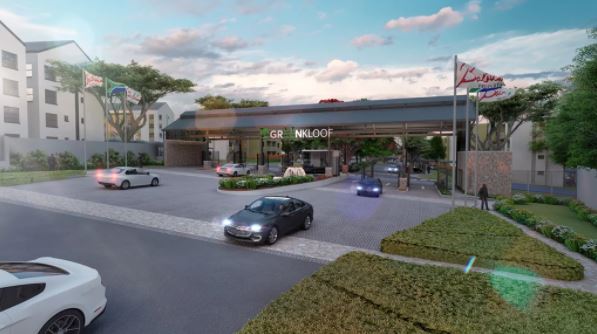
An artist’s representation of the Mooikloof megacity development.
On Monday, the Tshwane metro won a court battle against Eskom and the energy regulator Nersa, potentially bringing this flat-pocket council an additional income of R125 million per month.
This comes after Judge Anthony Millar set aside a decision by Nersa in the High Court in Pretoria. The Nersa decision gave Eskom the right to distribute power to the new Mooikloof Mega City in the east of Pretoria.
Mooikloof Mega City is a smart city development by Balwin Properties. It was in 2020 by pres. Cyril Ramaphosa introduced as one of 62 strategically integrated projects (also known as SIPs). The cost of the project was then set at R84 billion with 50 000 sectional title units in its first phase. This includes, among others, the Greenkloof and Mooikloof Eco-Estate development.
The battle over attractive power distribution business began in March 2022 when the metro council realized to its shock that Eskom had already submitted an application to Nersa about a year before to amend its power distribution license so that it could also serve the smart city.
The smart city was to be developed, among other things, on the farm Rietfontein 375-JR and Eskom asked that the farm be included in its licensed distribution area.
However, the farm had already been included in Tshwane’s distribution area since 2011 and in terms of the regulatory framework, licensees’ distribution areas may not overlap.
The area was largely undeveloped and Eskom distributed power to the few farms in the area, because Tshwane did not have the necessary infrastructure to serve them at that stage.
Tshwane’s license specifically read: “Customers who get their power from Eskom or any other licensed power distributor on the commencement date of this license are excluded from this license.”


Balwin’s founder and chief executive officer, Steve Brookes and Pres. Cyril Ramaphosa. (Photo: Jacques Naude/African News agency (ANA)
Tshwane objected to Eskom’s application at Nersa and emphasized that the farm was included in the area for which it holds the distribution licence. The council was never approached to give permission to Eskom to operate in its area nor was it asked to have its own license amended by transferring the area to Eskom.
The metro board has indicated that its current and planned new infrastructure is sufficient to fulfill its power distribution function.
Tshwane pointed out to Nersa that according to the Constitution power distribution is an exclusive municipal function and expressed his concern about the income he could lose if Eskom gets the right to distribute power there.
The income was calculated at R125 million per month.
During a meeting of Nersa’s sub-committee for electricity in December 2022, which makes recommendations to the regulator for a final decision, it was recognized that Eskom had no valid counter-argument for Tshwane’s claim to the exclusive constitutional right to distribute power. Nevertheless, the issue was left there.
During a meeting of the same committee in February 2023, members repeatedly raised the fact that the same farm where Eskom now wanted to distribute power was included in Tshwane’s license and that it had to be removed there before it could be awarded to Eskom.
However, this was never done and on 10 February Nersa gave the green light to Eskom.
Nersa and Eskom argued in court that Tshwane is misinterpreting the Constitution and that power distribution is not the exclusive domain of municipalities.


Pres. Cyril Ramaphosa during the launch of the development plan in 2020. (Photo: Siyabulela Duda)
To this the court responded as follows: “This claim is rejected. The Constitution unequivocally grants executive authority and jurisdiction over electricity distribution to Tshwane.”
The judge went further: “Nersa should not have approved Eskom’s license amendment without either considering the question of whether it was permissible in the absence of an amendment to Tshwane’s licence, or considering Tshwane’s constitutional position.
“This was of fundamental importance for the consideration of the question of whether Eskom’s application should be approved. This is the core of the review application and the reason why it must succeed.”
This ruling comes against the background of Eskom’s increasing involvement in power distribution in municipalities that owe it billions of rands for bulk purchases.
It has recently come to light that Eskom can take over as many as 30 municipalities’ power distribution, albeit as an agent of the municipality, while the municipality retains its distribution license.
However, the municipal association Salga calls it a takeover by default and has expressed its concern that it undermines municipalities’ exclusive right to distribute power, which was confirmed in this court ruling.