
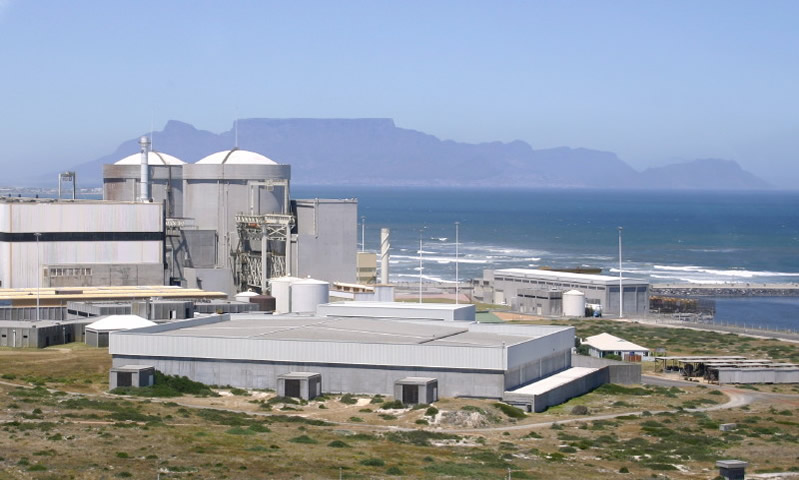
The Koeberg nuclear power plant outside Cape Town. (Archive photo)
The Cape Town metro is embroiled in yet another tariff dispute, this time over alleged over-recovery of power tariffs over several years, while questions also hang over the determination of the metro’s new tariffs for the financial year starting on 1 July.
It is a complicated matter that can ultimately be decided in the metro’s favour, says Deon Conradie, expert in electricity pricing.
This comes against the background of a recent court order which declared the metro’s cleaning charge and fixed water and sanitation charges, all based on property value, illegal. The Western Cape High Court overturned these rates, but suspended the order until June 30, which means the metro will likely have to rewrite its budget for 2026-27, which comes into effect on July 1, because it was drawn up on the same basis.
According to an internal Nersa document from last year that Maroela Media had a look at, the metro “charged 2.13% and 2.50% more to consumers respectively in the 2022-’23 and 2023-’24 financial year and is still charging about 4.5% more in the 2024-’25 financial year than the rate approved by Nersa.”
In 2022-23, Nersa approved a fare increase of 7.47% for the metro, but the city introduced 9.6%. In 2023-24, Nersa approved 15.1%, but the city set 17.6%.
Deviating from Nersa approved rates is illegal.
The subway did it anyway. Its fare increases were based on a cost-of-supply study and the metro asked the High Court to review Nersa’s decision for both periods.
The metro explained: “The figure of 4.5% (recovery) mentioned for 2024-’25 is not a new or additional rate determination, but rather the cumulative effect of the previous two years (2022-’23 and 2023-’24), which is the subject of review applications.”
Conradie says that although it is illegal for anyone to charge rates for the sale of electricity that have not been approved by Nersa, the court found in other litigation that the regulator itself broke the law in its rate determinations.
The Electricity Regulation Act states that a license holder (for example a municipality) must recover the effective costs of service delivery plus a reasonable margin.
However, for many years Nersa applied a guideline and benchmark methodology that simply indicated to municipalities by what percentage they could increase the previous year’s rates, without reference to the actual costs.
In October 2022, this methodology was declared illegal and set aside in the High Court, and Nersa was ordered to switch to a cost-of-supply method. The regulator has been given 12 months to change its way of working.
If the metro had complied with Nersa’s provision, it would have acted in contravention of the Electricity Regulation Act, says Conradie. The court will take this into account when deciding the case, and the metro may therefore be able to get away with ignoring its regulator.
The two review applications were already heard in December 2024, but no judgment has yet been delivered. The metro says: “Several requests to the court and the judge president about the delay in the delivery of these judgments have not yet yielded any result.”
The pending case affects rate determinations in subsequent years and further litigation may follow.
“As there is still no agreement on the baseline against which new increases should be measured – with review judgments still outstanding – Cape Town Metro is also in the process of instituting review proceedings for 2025-’26,” says the metro.
“For the current 2025-’26 (-rates), Nersa further failed to officially notify the City of its determination before the start of the new financial year, and this was recorded in the council decision when the budget was accepted, given the constitutional obligations to have a budget ready in time,” says the metro.
The metro refers to the legislative requirement that municipalities must implement an approved budget on 1 July of each year, as well as the restriction that new rates may only be introduced on that date.
While the metro’s review applications are still pending, further litigation has focused on Nersa’s illegal practices in setting municipal electricity rates.
In October last year, the North Gauteng High Court ordered Nersa to publish each municipality’s tariff application together with its cost-of-supply study for public scrutiny. The City of Cape Town participated in the proceedings, which were originally brought by AfriForum, and “has since successfully ensured that Nersa is bound by deadlines set by the court from 2026-’27 and is now monitoring the regulator’s ability to adhere to them,” the metro said.
Meanwhile, Nersa announced on 12 May that it was going to approach the court for the second time to relax these deadlines, this time because it could not complete 14 municipalities’ tariff applications for 2026-’27 in time before the deadline of 11 May.
The regulator did not indicate which municipalities these are.